Closed-House Conditions
Short-term tests should be run with windows and external doors kept closed, so the measurement reflects the building near its realistic worst case rather than its best.
York County, Pennsylvania
Testing is cheap, and it is the only thing that tells you anything real about your own property. A neighbour's result is not your result.
Call (717) 555-0143Radon concentration depends on the soil and rock directly beneath a specific building and on how that specific foundation is constructed and ventilated. Two houses on the same street, built in the same year by the same builder, can test very differently. This is why county averages and neighbours' results are close to useless for deciding whether to mitigate.
The Pennsylvania Department of Environmental Protection estimates 40 percent of homes tested in the Commonwealth exceed the EPA action guideline of 4 picocuries per litre. That is a compelling reason to test. It is not a reason to mitigate without testing — plenty of York County homes test low, and a mitigation system installed without a measurement is money spent on an unknown.
A do-it-yourself short-term kit costs very little and is sufficient for an initial screening. Where it is not sufficient is in a real estate transaction, or where the result will be relied on by someone other than you.
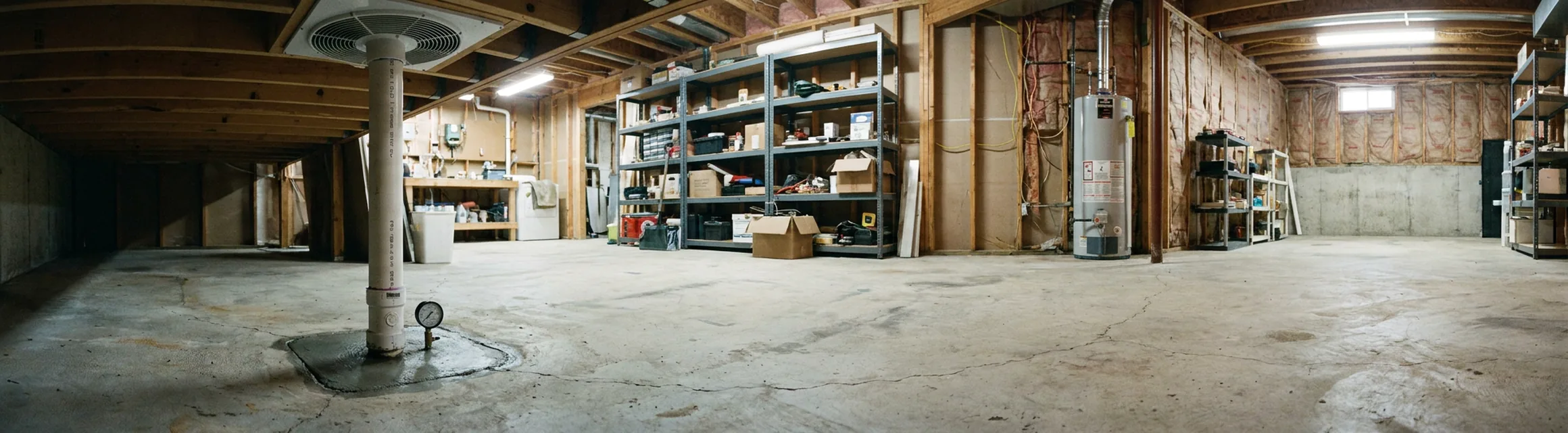
Four situations, four different answers. Matching the test to the situation saves both money and a wasted result.
| Situation | Test type | Why |
|---|---|---|
| First-time screening | Short-term DIY kit | Cheap, widely available, sufficient to tell you whether to look further |
| Screening came back near 4 pCi/L | Long-term test | Levels fluctuate; a 90-day-plus test gives a far better annual picture |
| Real estate transaction | DEP-certified tester | The result is relied on by another party and needs documented chain of custody |
| After mitigation | Post-mitigation test | Demonstrates the system is actually working, not merely installed |
| Ongoing peace of mind | Continuous monitor | Shows day-to-day variation and confirms the system keeps working |
| Well water supply | Separate water test | Waterborne radon is a distinct pathway that an air test will not characterise |
Testing certification in Pennsylvania is required for activities including placing and retrieving radon testing devices for others. A homeowner testing their own home with a DIY kit is a different situation from a tester engaged to produce a result someone else will rely on.
Short-term tests should be run with windows and external doors kept closed, so the measurement reflects the building near its realistic worst case rather than its best.
The lowest level of the home that is or could reasonably be occupied, away from drafts, exterior walls, humidity and heat sources.
Short-term tests usually run two to seven days. Long-term tests run 90 days or more and give a much better representation of the annual average.
DIY kits are returned to a laboratory for analysis. Pennsylvania certifies radon laboratories as well as testers and mitigators.
At or above 4 pCi/L the EPA recommends action. Between 2 and 4 pCi/L, mitigation is worth considering. There is no level considered entirely risk-free.
After mitigation, after significant foundation work, and periodically thereafter — conditions change over the life of a building.
Tell us the situation — screening, a borderline result, a sale, or a post-mitigation check — and we will point you to the right one.
Inexpensive, widely available, and enough to establish whether you have a question worth pursuing.
If the first result sits near the action level, run a long-term test before committing to mitigation.
Transactions and any result another party will rely on call for a DEP-certified tester.
At or above 4 pCi/L, mitigate. Get itemised quotes and verify certification before hiring.
For an initial screening, yes — provided you follow the instructions on placement and closed-house conditions, and return the kit to the laboratory promptly. Most testing error is procedural rather than a fault in the device. Where a DIY kit is not appropriate is where someone other than you will rely on the result.
Short-term tests generally run two to seven days, plus laboratory turnaround. Long-term tests run 90 days or more. If you are in a transaction with a deadline, start the test early — this is the most common avoidable delay we hear about.
The lowest level of the home that is occupied or could reasonably be occupied — for most York County houses, the basement. Keep it away from drafts, exterior walls, windows, sumps, heat and high humidity, and roughly at breathing height rather than on the floor.
Yes. Radon depends on the ground directly beneath your foundation and on how your building is constructed and ventilated. Neighbouring properties routinely produce very different results, and a low reading next door is not evidence about your house.