Verify on the DEP List
Check the firm and the individual against the Pennsylvania DEP Radon Division's certified lists, and confirm the certification is current.
Pennsylvania Certification
Pennsylvania certifies radon testers, mitigators and laboratories. Checking that certification takes a few minutes and is the most useful thing you can do before hiring anyone.
Call (717) 555-0143The Pennsylvania Department of Environmental Protection administers a certification programme covering radon testing, radon mitigation and radon laboratory analysis, for individuals and for firms, under the Commonwealth's Radon Certification Act. This is not a voluntary trade association membership or a logo a company can simply display. It is a state requirement for performing this work in Pennsylvania.
DEP's Radon Division publishes lists of certified individuals and firms, and those lists are the authority. A company website saying it is certified is a claim; the DEP list is the verification. Check the name of the firm and, where you can, the individual who will actually perform the work, and confirm the certification is current rather than lapsed.
This is also the cleanest way to filter out the least serious operators. A contractor who becomes evasive when asked for a certification number has told you what you needed to know.
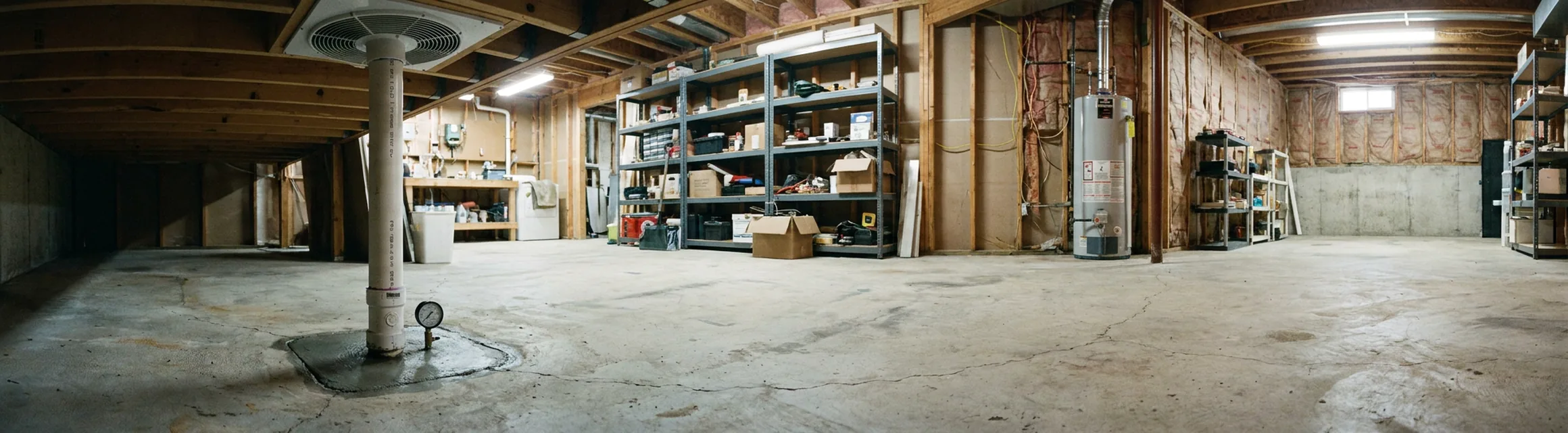
Radon quotes vary because the work varies. These are the line items that explain the difference, and the ones to insist on seeing.
| Line item | Why it moves the price | Ask for |
|---|---|---|
| Number of suction points | Large or segmented slabs may need more than one | How many, and why that number |
| Foundation type | Basement, slab, crawlspace or a combination | How each area will be treated |
| Pipe routing | Interior routing through conditioned space costs more than exterior | Where the pipe will run, and how it will look |
| Fan specification | Models differ in capacity, noise and warranty | Model number and warranty length |
| Sealing work | Cracks, sump pits and penetrations affect system performance | What will be sealed and how |
| Post-mitigation test | Demonstrates the system actually works | That it is included, and what happens if it fails |
| Electrical work | Fans need a dedicated supply, sometimes a new circuit | Whether it is included or extra |
A quote that is a single number with no itemisation is not comparable to anything. Ask for the breakdown — a competent mitigator will provide it without being pushed.
Check the firm and the individual against the Pennsylvania DEP Radon Division's certified lists, and confirm the certification is current.
A straightforward request. Hesitation in answering it is itself informative.
General liability insurance, and confirmation that the work being carried out is within its scope.
Suction points, fan model, routing, sealing, post-mitigation test and electrical work as separate lines.
Many mitigators guarantee the system will bring the home below 4 pCi/L. Confirm what happens if the post-mitigation test fails.
Fans are mechanical and eventually fail. Know the fan warranty, the workmanship warranty, and what each covers.
Tell us what you have been quoted and we will tell you what the quote is missing.
Do not accept a mitigation quote without a measurement. The test result is what determines whether and how much work is needed.
Check every contractor you are considering against the DEP certified list before inviting them to quote.
Two or three, itemised, so you are comparing scope rather than headline numbers.
Post-mitigation testing included, with a clear remedy if the system does not achieve the target.
The Pennsylvania DEP Radon Division publishes lists of certified radon testing, mitigation and laboratory individuals and firms. Look the company up there, and ask the contractor directly for their certification number. Verify it is current — certifications lapse, and a company that was certified three years ago may not be today.
Not on its own in Pennsylvania. National programmes exist and are a reasonable sign of training, but Pennsylvania runs its own certification requirement for this work. The state certification is the one that is legally required here.
A competent mitigator will return and adjust the system — commonly by adding a suction point, upgrading the fan, or improving sealing. Establish before you sign what the contractor's obligation is if the post-mitigation test does not meet the target, and get it in writing.
Yes, two or three. Not primarily to drive the price down, but because comparing itemised quotes is the fastest way to understand what your particular building actually needs. Where two contractors propose different numbers of suction points, ask each to explain their reasoning.